Comparison GPR Systems Utility Detection UT FieldLab
Léon olde Scholtenhuis
Organisation || T&A Survey
Candidate || Pahul Singh
Type of project || BSc thesis [download]
Period || Apr 2026 – Jul 2026
GPR systems sharing the same antenna frequency are widely assumed to perform equivalently under identical soil conditions. Nevertheless, the various developers of GPR systems create slightly different units, with other antenna configurations, logging systems, data processing and interfaces. So, there is more than just an antenna frequency, when it comes to selecting GPR for Utility Mapping fieldwork.
This research therefore compared two 500 MHz systems, PulseEKKO and Zond, across twelve controlled configurations at the UT Field Lab, varying soil type (sand, mixed, clay), moisture level, and surface cover.
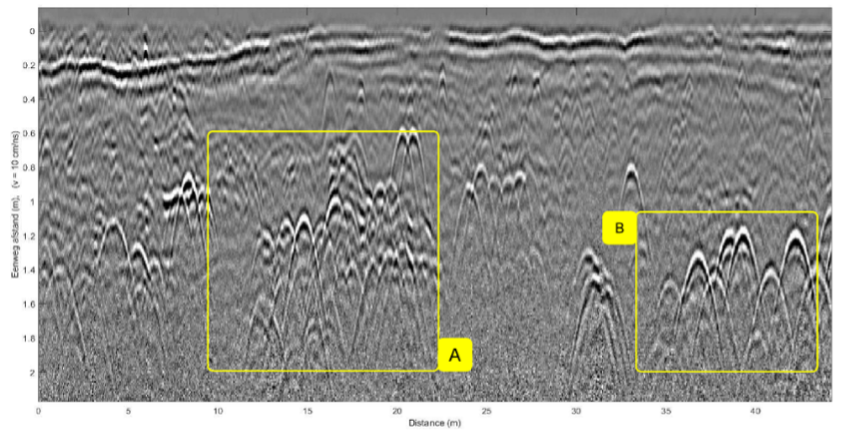
The figures illustrate the difference in performance of two identical systems in the same conditions (the report shows more analysis)
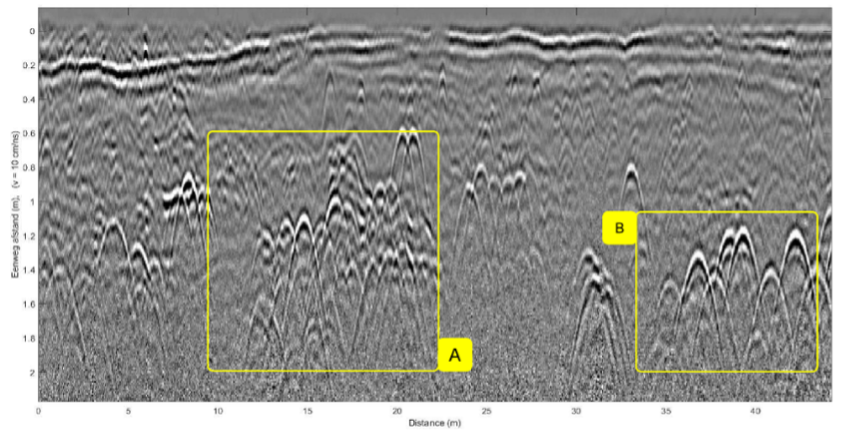
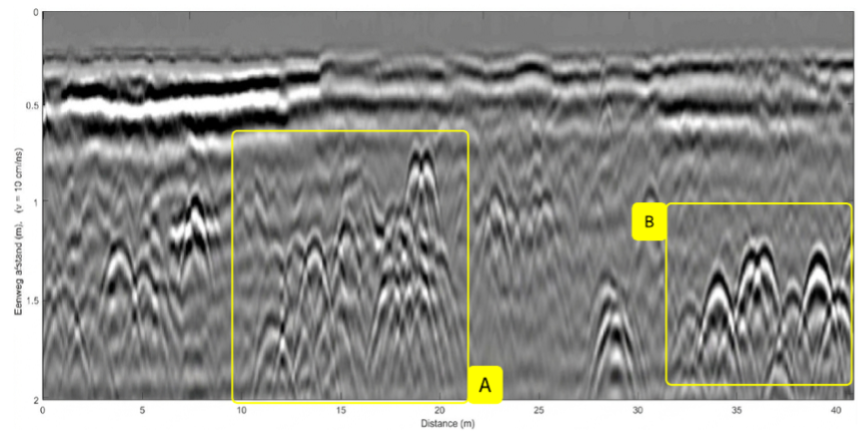
Results show that soil type was the dominant performance driver. In sandy, low-moisture conditions, the PulseEKKO outperformed the Zond in spatial resolution, producing sharper, better-separated hyperbolic reflections. As clay content and moisture increased, both systems degraded progressively and converged toward near-identical, severely limited performance. Surface cover had no effect on penetration depth or resolution; its only practical relevance was preventing localised signal loss from standing surface water on unpaved, fine-grained soils.
The report proposes a simple flowchart to guide system selection under different conditions, which is presented below as well.
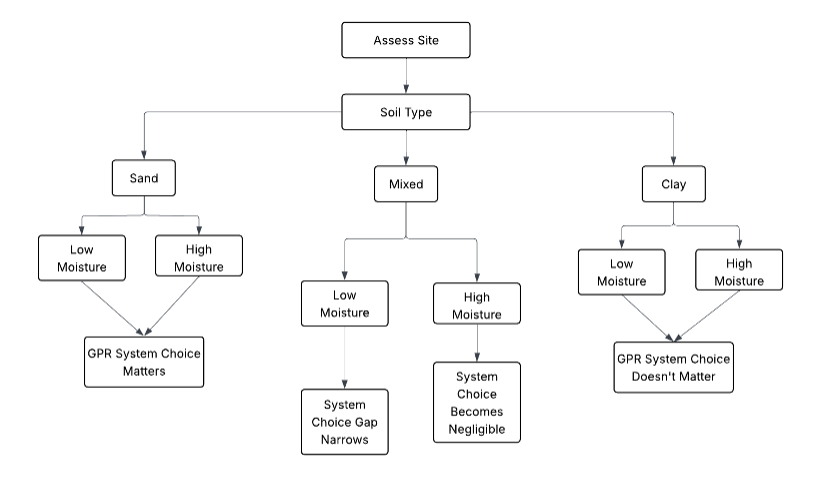
Flowchart for selecting GPR system: which factors influence GPR performance? When does GPR system selection matter?