Developing a Unified Approach for Test Trench Information Exchange
Léon olde Scholtenhuis
Organisation || Allinq Group BV
Candidate Eng || Faith Tangara
Start - end || February 2025 - 2027
Excavation activities in the Netherlands are increasing due to the energy transition, the rollout of fibre-optic networks, and urban redevelopment. With more work taking place in an already crowded subsurface, the risk of damaging cables and pipelines in the subsurface continues to rise. Although resources such as KLIC provide access to registered utility information, this data is typically limited to two-dimensional representations and often lacks depth information and positional accuracy. This drives the use of test trenches (‘proefsleuven’) to verify the actual location, depth, utility crossings, and condition of the underground assets prior to or during works.
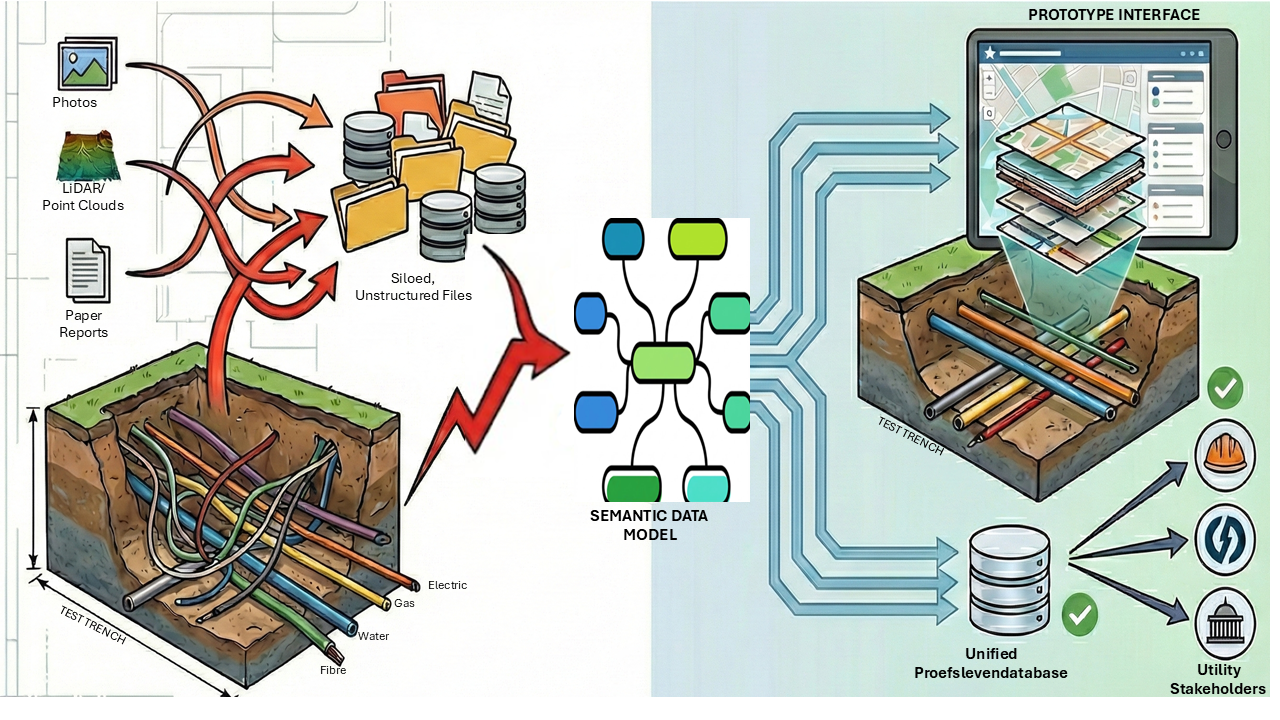
Test trenches generate high value field-verified information with up to centimeter-level detail. This is often captured using traditional tape wire and GPS, but may in future be captured using 3D methods such as photogrammetry, LiDAR scanning, and georeferenced imagery. In current practice, trench ends up mixed up as photos, reports, and point clouds as project-specific files. After backfilling trenches, and completion of streetworks, the verified knowledge is often challenging to find, compare, or reuse across different projects and organizations. The result is repeated trenching in the same area, avoidable costs, and persistent uncertainty during planning and execution.
This project addresses the question of how verified test trench data can be shared and reused in a structured manner. The project focuses on the design of a semantic data model that provides a common vocabulary for describing test trenches, observed utilities, and verification activities. The model builds on existing Dutch information model NEN 3610 and IMKL, and applies linked data principles to enable interoperability between the current heterogeneous datasets. A prototype interface will be developed to demonstrate how semantically enriched test trench data can be queried and visualized across sources.
The results are intended to inform future developments of a “proefsleuvendatabase” (by COB) and provide a reference framework for organizations seeking to improve the reliability and governance of subsurface data exchange.