Validating and Improving a Machine Learning Model for GPR Deployment
Léon olde Scholtenhuis
Organisation || Siers Infraconsult
Candidate || Laia Salvat Vives
Type of project || BSc thesis [download]
Period || Apr 2026 – Jul 2026
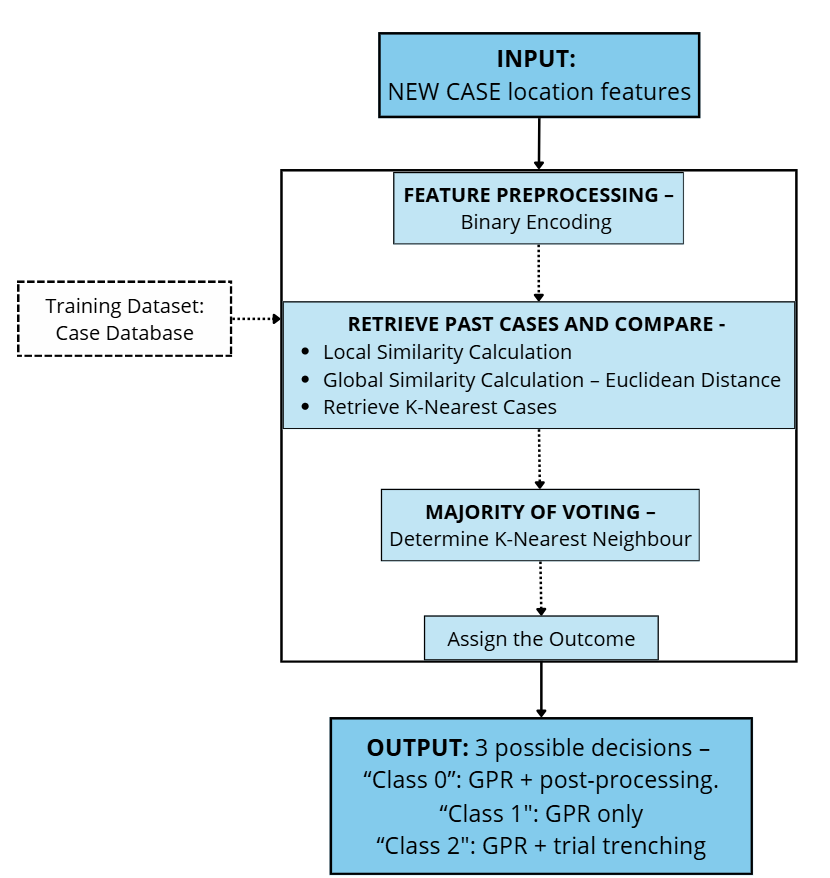
Selecting a proper method to identify a buried utility on site requires expertise about infrastructure and GPR equipment - both of which are not readily available at a construction site. To aid in the decision to dig a trial trench, or deploy the GPR to scan an area, UT researchers have previously developed a machine learning model. This model uses Case Based Reasoning (CBR).
This CBR machine learning decision-making model for underground utility surveying had been developed and appeared to perform well in testing conditions, but still lacked real-world application and validation. Laia’s research aimed to test the tool’s applicability using surveying cases and explore opportunities to simplify and improve the model. Twenty-three cases from utilities contractor Siers Infraconsult were collected and used for empirical validation by comparing model predictions with actual site decisions, alongside sensitivity and robustness analyses.

Image of a trail trench registration - at the courtesy of Siers Infraconsult (2026)
While the original model showed insufficient performance, the results revealed a mismatch. The trained system appears to propose geophysically/technically optimal solutions, whereas operators often make decisions based on pragmatic criteria (e.g. whether site conditions permit GPR scanning, the costs of deploying, the time available for scanning, but also the habit of using trial trenches). Analyses identified features for the CBR model that could be removed. Finally, a simplified binary model improved predictive capability, showing potential for supporting decisions on whether trenching is required. Future research will focus on how expert operator’s logics and geophysically optimal decisions can be bridged.
Schematic visualisation of the Case Based Reasoning model developed and tested in the study